
When bringing a complex residential scheme to life, getting planning permission isn’t always the end of the journey. Sometimes, the devil is in the detail—specifically, the planning conditions attached to the decision notice.
For developers and investors, restrictive conditions can drastically alter a project’s strategy, cap ROI, and limit long-term exit options.
At Cosy Hauz, we recently secured a significant planning appeal victory for our own project in Banstead. By appealing a restrictive condition imposed by Reigate and Banstead Borough Council, we successfully removed the barrier preventing a C3 (family dwelling) to C4 (HMO) conversion via Permitted Development—restoring the site’s full potential and commercial flexibility.
Here is a breakdown of how we won this C3 to C4 HMO appeal in Banstead and what it means for your own planning strategies.
The Banstead Project Background
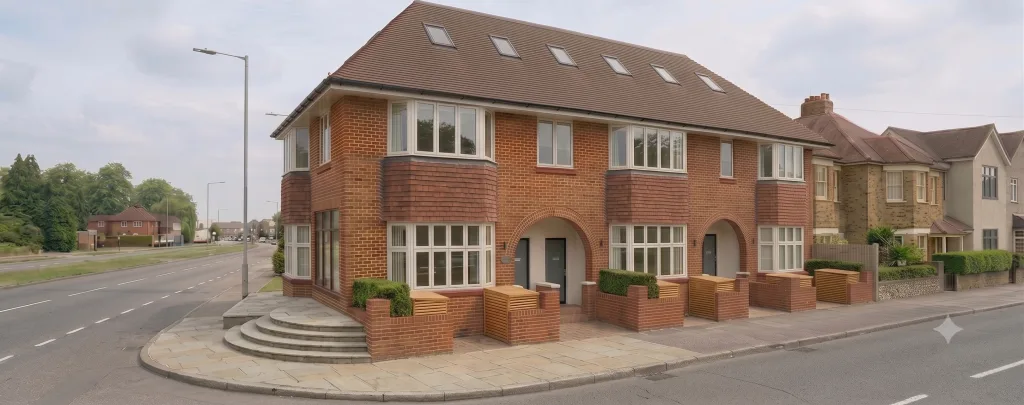
The subject site, located in an established residential neighbourhood in Banstead on the corner of Ferndale Road and Brighton Road, comprised:
- A two-storey corner building featuring a ground-floor commercial unit (Class E)
- A self-contained residential flat on the first floor (Class C3)
- Dilapidated single-storey garages and a rear yard area
Our primary goal was to maximise the value of the underutilised land and commercial space through strategic planning applications.
OUR PLANNING STRATEGY
| 1. Pre-Application Advice | We presented the refined scheme & addressed case officer concerns early. |
| 2. Highways Consultation | We successfully secured “no objection” on parking stress surveys. |
| 3. Class MA Prior Approval | We applied commercial-to-residential as a fallback position. |
| 4. Full Planning Applications (2 & 3 Terraced Dwellings) | We finally secured approvals for both 2 and 3 terraced dwellings. |
The Roadblock: Restricting C3 to C4 HMO Rights
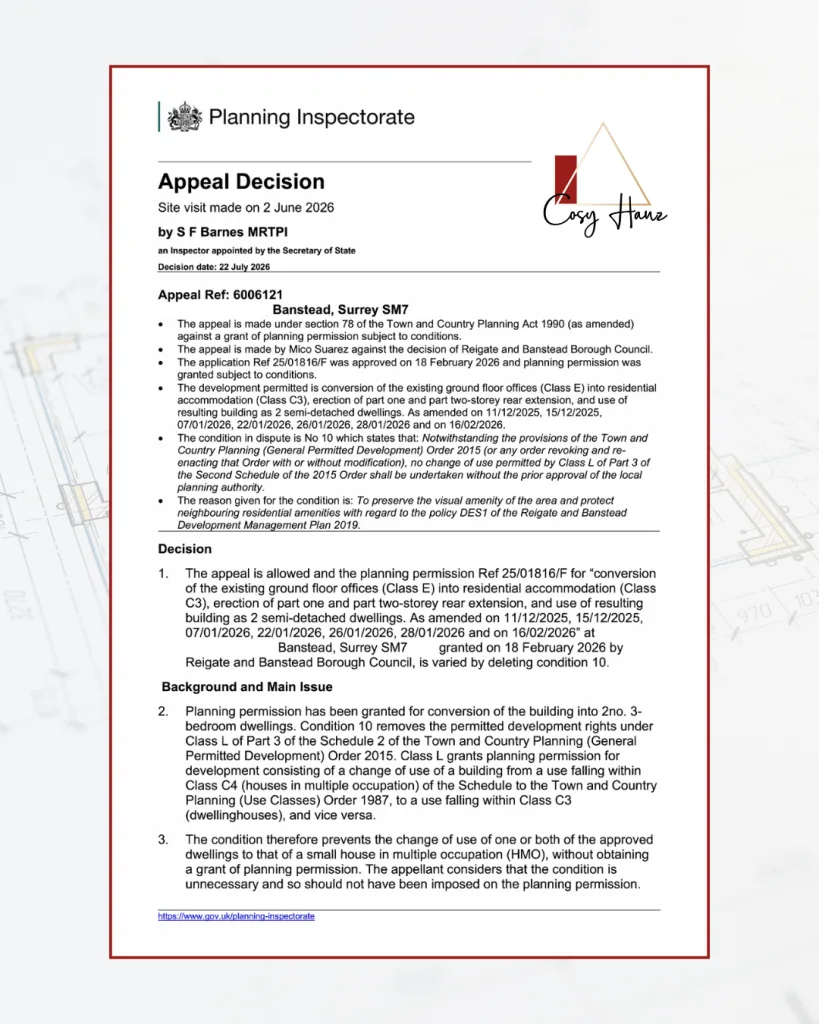
While the council granted planning permission for the conversion of the ground-floor office into semi-detached C3 dwellings, they attached Condition No. 10.
This condition removed Class L Permitted Development (PD) rights, preventing the future owner from converting the C3 residential properties into C4 Houses in Multiple Occupation (HMOs) without full planning permission.
The council cited policy DES1 of the Reigate and Banstead Development Management Plan to preserve local visual and residential amenity. However, this blanket restriction effectively capped the commercial potential and operational flexibility of the site.
Our Winning C3 to C4 Appeal Strategy
Believing the condition to be disproportionate and unjustified, we lodged an appeal with the Planning Inspectorate. We built our argument on four robust core pillars:
1. Failure of NPPF and PPG Tests
Under the National Planning Policy Framework (NPPF) and Planning Practice Guidance (PPG), planning conditions must be necessary, relevant, and reasonable. We argued that the council imposed the condition pre-emptively to retain future discretionary control, rather than addressing any actual, identified planning harm.
2. Absence of Local Evidence in Banstead
The council operated a site-specific “micro-Article 4” direction without the requisite evidence. We demonstrated that:
- There was no local Article 4 direction in place in the area.
- There was no overconcentration of HMOs in the Banstead locality (only one identified HMO within 1km).
- No site-specific amenity or highway impacts were proven.
3. Alignment with National Planning Judgment on HMOs
Class L of the GPDO reflects a national consensus: converting small family homes (C3) to small HMOs (C4) is generally compatible within residential areas. The council failed to show why this site warranted exceptional treatment compared to neighbouring residential properties retaining their standard PD rights.
4. Fallback Comparison & Real-World Impacts
We highlighted that six unrelated occupants in a C4 setup generate no greater impact on noise or parking than six occupants living as a single C3 household. Furthermore, our parking surveys confirmed sufficient capacity, and the existing commercial Class E fallback could legally generate far greater traffic and activity.
The Outcome: Full Commercial Flexibility Restored
The Planning Inspectorate agreed with our arguments and allowed the appeal, deleting Condition No. 10 in full.
This key win not only restored the HMO strategy for the 2-dwelling scheme, but it also established clear precedent for our next step: submitting a Variation of Condition application for the 3-dwelling scheme to unlock maximum value across the entire development.
Key Takeaway
Planning Inspectorate Decision: Councils cannot restrict Permitted Development rights (including C3 to C4 HMO conversions) simply to retain control. Any restriction must be backed by tangible evidence of site-specific harm.
If you have been issued a restrictive decision notice or are dealing with onerous planning conditions on your residential or HMO development, please do not hesitate to contact the Cosy Hauz team for advice and guidance.
You can also explore Cosy Hauz’s full range of expert development solutions on our Planning & Design Services page to see how we help developers optimise site value and overcome complex planning hurdles.
Stay connected with us and stay up-to-date on company news and projects by following our social media pages:
Facebook: Cosy Hauz
Instagram: @cosyhauzuk
Linkedin: Cosy Hauz
